From mid-September 1989, I was in a prison in Karl-Marx-Stadt. Most of the time, I was
alone in a cell. I received no visits and had no contact whatsoever with the outside
world. Only later did I learn that my mother’s letters, which she had continued to send
to Cottbus, had been returned to her unanswered.
I did not know what decisions were being made about me outside my cell. While I lived
in complete uncertainty, a precisely defined procedure was already under way in the
authorities’ offices.
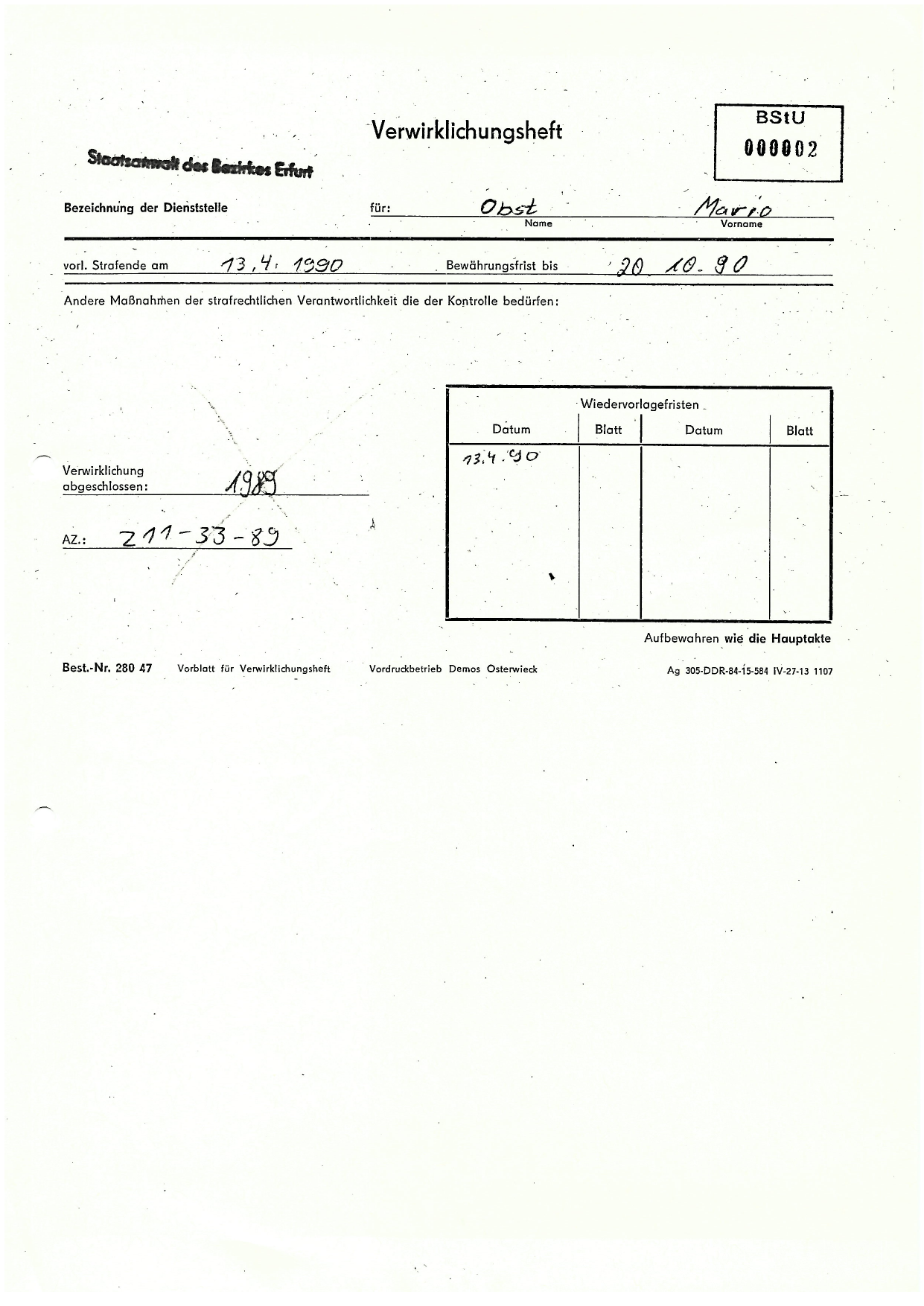
The sentence enforcement file: the bureaucratic record of the enforcement and later
suspension of my prison sentence.
On paper, the day had long been fixed
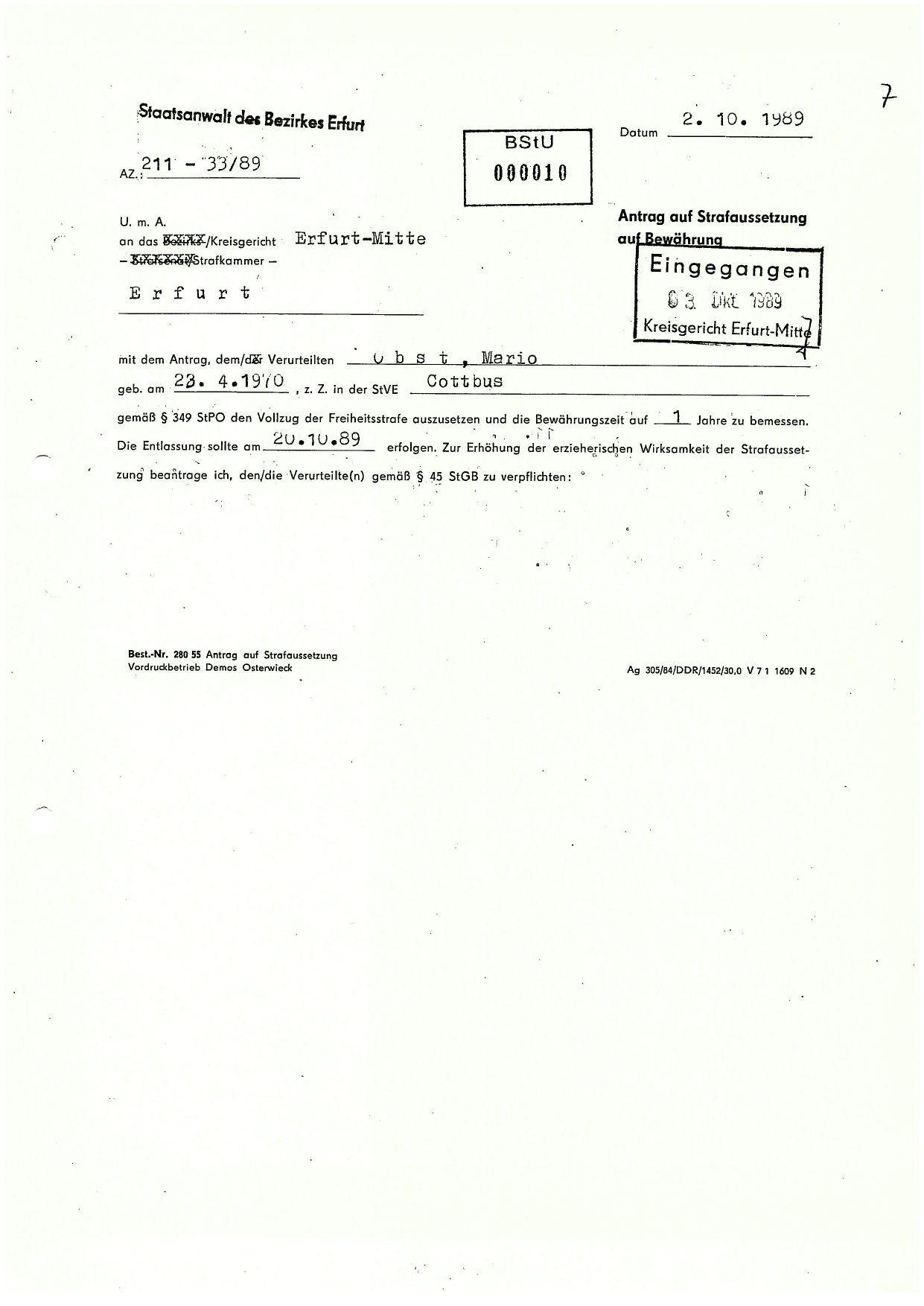
On 2 October 1989, the Erfurt District Public Prosecutor applied for the remainder of
my prison sentence to be suspended on probation. The application already contains the
decisive sentence: “Release should take place on 20 October 1989.”
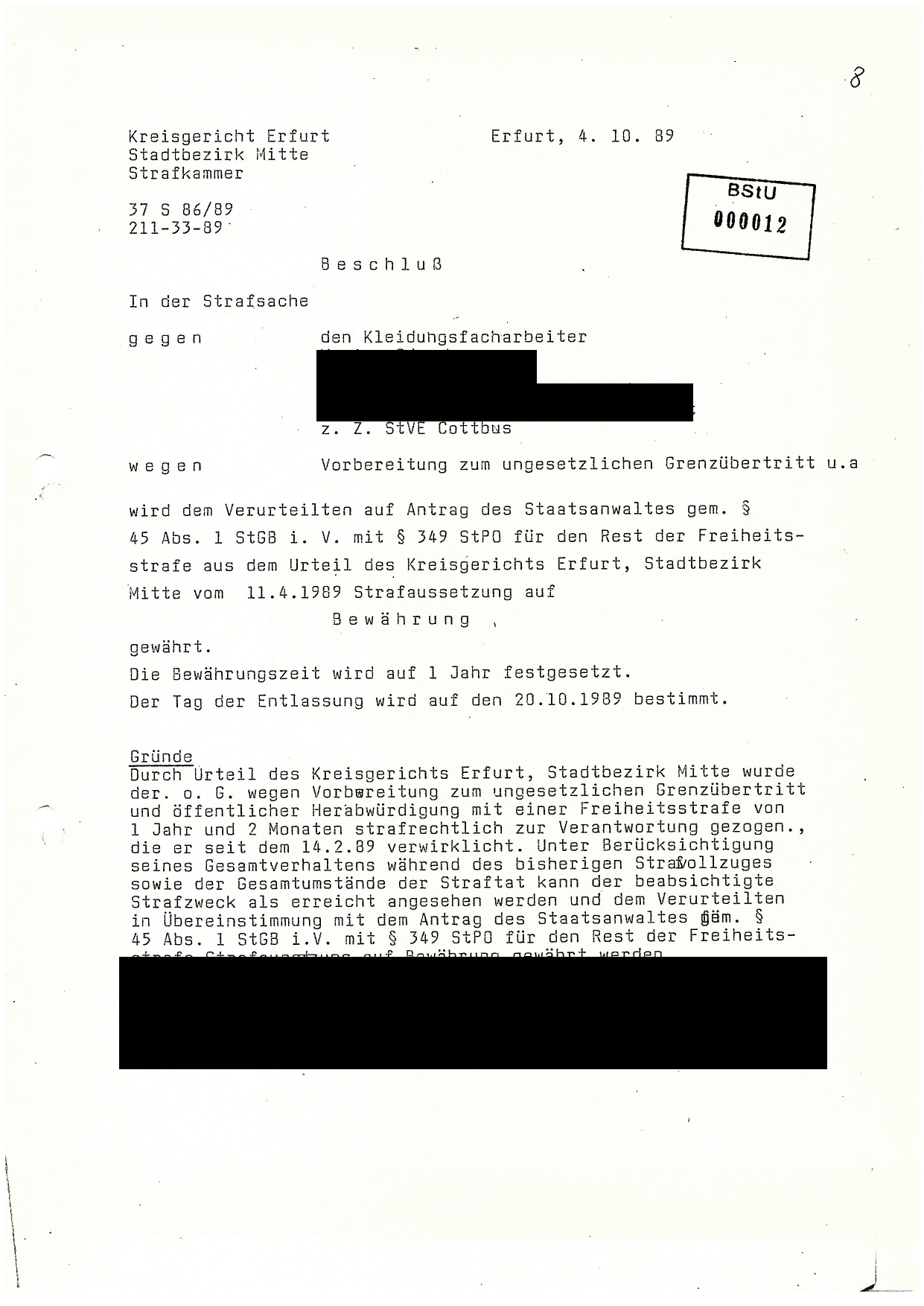
On 4 October, Erfurt-Mitte Local Court granted the application. It suspended the
remaining sentence for a probationary period of one year and expressly stipulated:
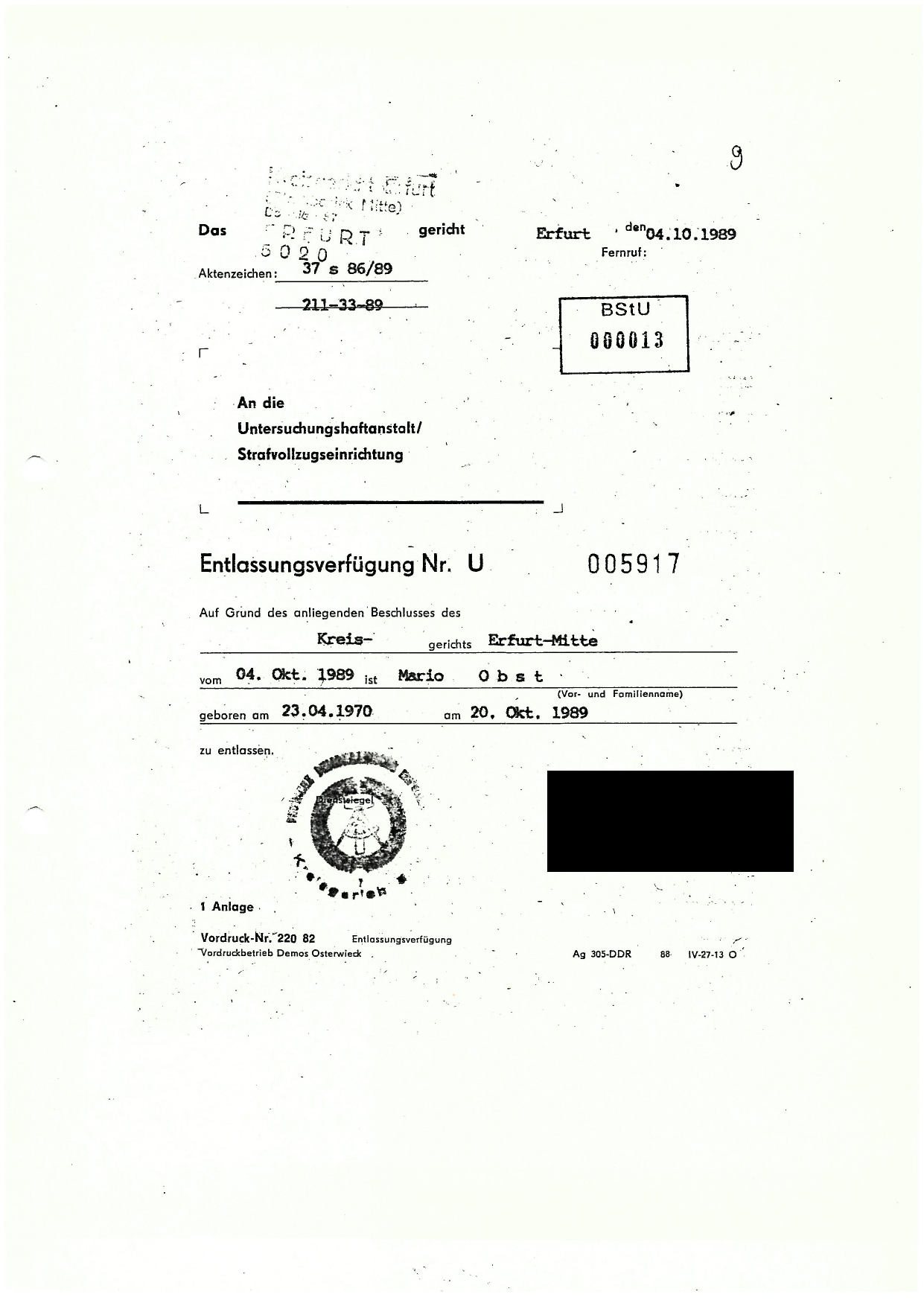
“The date of release is fixed as 20 October 1989.” A separate release
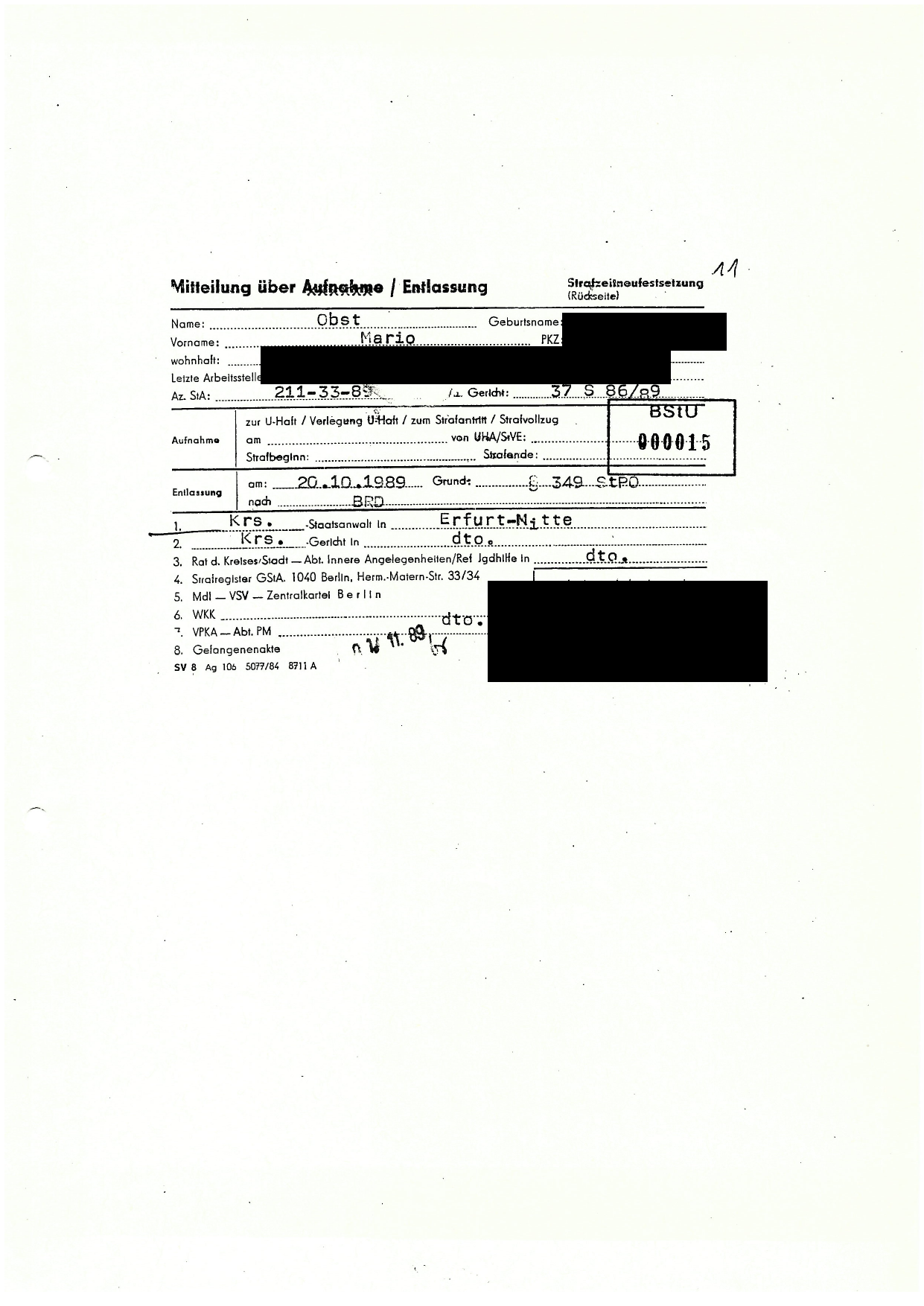
order was issued that same day. A later notification records my destination on release
unmistakably: “to the Federal Republic of Germany”.
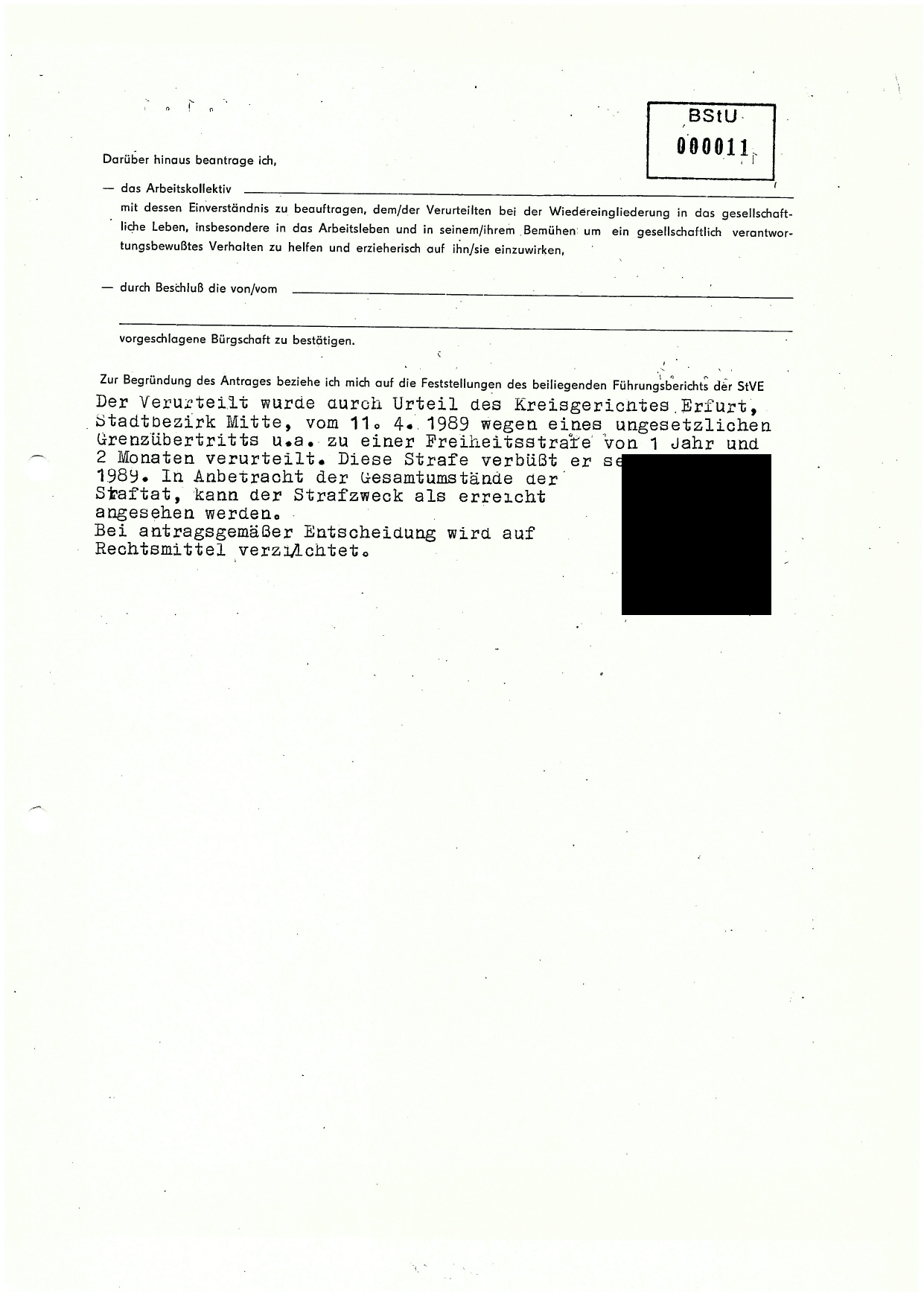
Page 4: application to suspend the sentence; release is to take place on 20
October.Page 5: the prosecution declares that the purpose of the sentence has been
achieved.Page 6: court decision fixing the release date.Page 7: the separate release order.
The early morning of 20 October
Very early in the morning, several men suddenly appeared at my cell door. They told me
to step outside. Men walked in front of me and behind me. They took me to a room where I
was given a new shirt. The room looked like a small photographic studio: lights, a chair
and a camera.
I had to take off my own glasses. Instead, they put glasses without lenses on me and
took photographs. Afterwards, I had to put my usual prison shirt back on.
I was then led to the showers. I showered and found my clothes in the next room: the
belongings from the property store that I had been wearing when I was arrested.
Cigarettes, chocolate and a pink document
Next, I entered a room that reminded me of the little shops children set up to play in.
Various products were laid out there. I had to use my remaining money to buy something.
I chose cigarettes and chocolate.
They gave me a pink document. Opened out, it was about A5 in size; folded, about A6. It
contained the photograph taken shortly beforehand, along with my name and date of birth.
The nationality field was blank.
Nobody explained exactly what this document meant or what was going to happen to me.
A train heading somewhere unknown
I was driven to the station in an unmarked vehicle. I still did not know what was
happening. Nobody spoke, and I asked no questions either. After such prolonged
isolation, you do not talk much any more.
They put me in the first carriage of a train and took me to a compartment. The only
instruction was that I would be shot if I left the train.
The train set off. I did not know where it was going. Only several stops later, at a
station, could I see that it was heading towards Frankfurt am Main. I stayed in my
compartment.
Gerstungen, Bebra — and suddenly the West
At Gerstungen, the East German border inspectors walked past my compartment. Only at
Bebra did the West German Federal Border Guard come to me and ask for my papers. All I
had was the pink document, the chocolate and the cigarettes.
The officers told me I had to go to Gießen. I got off at the next station in the West
and went to the station welfare service, the Bahnhofsmission. They helped me find the
right train. When I asked about a ticket, they said I did not need one: I should simply
show the pink document, and their colleagues would know what to do.
In Gießen, I was to contact the Bahnhofsmission again. When I arrived, they explained
how to get to the reception camp. I went there.
What happened there belongs to a new chapter.
What the file establishes — and what it leaves unsaid
The sentence enforcement file documents the administrative preparations: the
application on 2 October, the court decision and release order on 4 October, an internal
forwarding instruction without a clearly legible date, and my release on 20 October 1989
with the destination “to the Federal Republic of Germany”.
In early October, the file still lists me as “currently at Cottbus penal institution”.
My actual detention in Karl-Marx-Stadt does not appear in these extracts. Nor does the
file tell of my isolation, the absence of visits, my mother’s returned letters, the
morning procedure, the death threat on the train or my uncertainty. The forms knew my
release date. I did not.
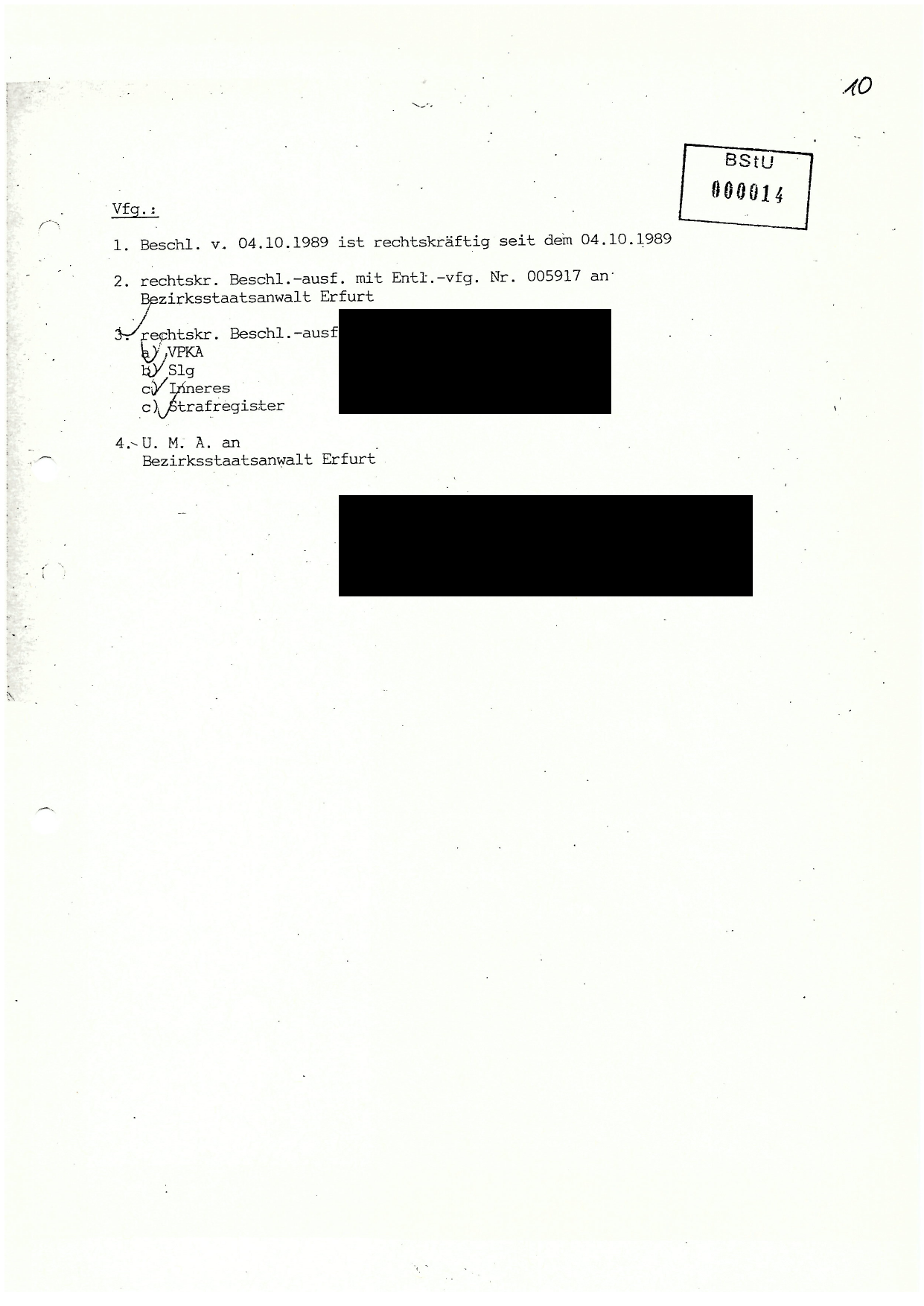
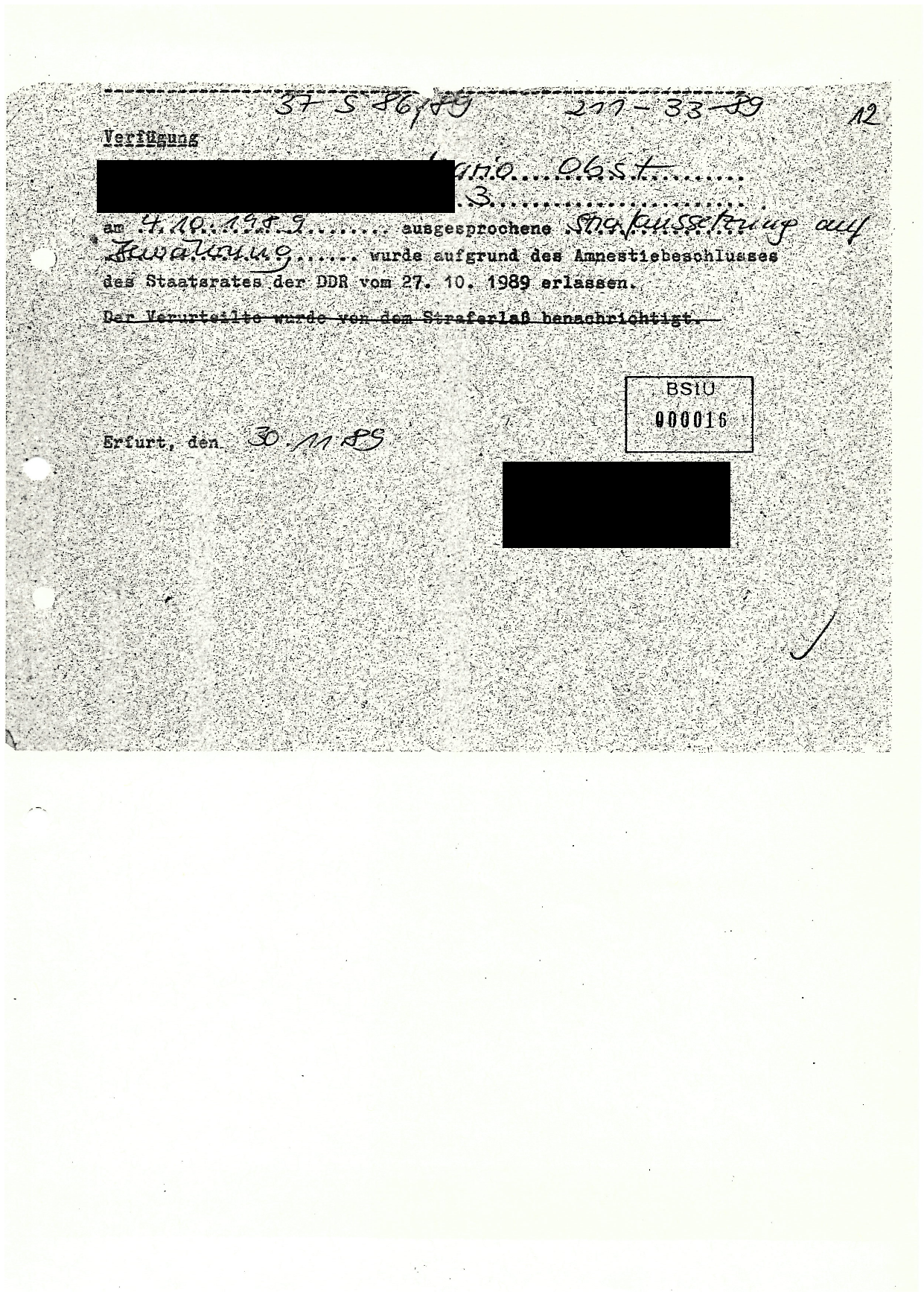
Page 8: internal forwarding of the decision.Page 9: release on 20 October 1989 — “to the Federal Republic of
Germany”.Page 10: later entry concerning the amnesty decision of 27 October
1989.
The amnesty decision of 27 October cannot have been the reason for my release: by then,
I had already been in West Germany for a week. The later entry instead concerns the
remainder of my sentence that was still suspended on probation.
Source: Federal Archives — Stasi Records Archive, sentence
enforcement file 764/89 (extracts). To protect privacy, personal contact details,
personal identification numbers, signatures and individual internal details have been
permanently redacted. Only newly rasterised image files are published, rather than the
editable source PDF.